


Introduction
People visit online publications for different reasons. Some want to understand a technology trend, while others are researching a business question, looking for educational information or exploring a health-related topic. A website covering several subjects can make this process easier by bringing different types of articles together.
TheSindi.com is described as a multi-topic digital publication offering informational articles and practical guides across areas such as technology, finance, business, education, health, lifestyle, law and travel.
Its broad subject coverage means readers can explore different interests without limiting themselves to one particular industry. However, finding a useful article involves more than clicking the first search result. Readers should understand the website’s subject areas, identify the information they need and check whether an article is suitable for their purpose.
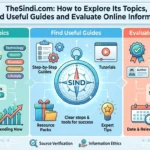
This guide explains how readers can approach TheSindi.com, explore its reported content categories, identify useful articles and evaluate information before using it in everyday decisions.
What Is TheSindi.com?
TheSindi.com is presented in third-party descriptions as an independent, English-language digital publication. Its reported tagline is “News, Insights & Expert Guides”.
The website is associated with informational articles, explainers and practical guides rather than a single specialist subject. Its reported content covers several areas of everyday interest, including business, finance, technology, education, health and lifestyle.
This type of publishing model is often called a multi-niche blog or general-interest digital publication.
Instead of focusing exclusively on technology or finance, a multi-topic website allows readers to explore several subjects in one place. Someone researching a business concept might also find articles about digital tools, education or personal finance.
The distinction is important: a broad publication can introduce readers to different subjects, but individual articles should still be assessed according to their accuracy, depth and relevance.
Research note: The live TheSindi.com homepage returned an access restriction during research. Therefore, the descriptions of its categories and publishing approach in this article are based on third-party reports and indexed references, rather than a complete live inspection of its current navigation.
Exploring the Main Categories on TheSindi.com
TheSindi.com is reported to cover several major subject areas. Understanding these topics can help readers decide which type of article is most relevant to their interests.
1. Technology and Gaming
Technology is one of the reported categories associated with TheSindi.com.
Technology-related articles can help readers understand digital developments, software, online services and changing technology trends. Topics may include artificial intelligence, cybersecurity, blockchain, gadgets and digital platforms.
Gaming is also mentioned in third-party descriptions of the website’s content.
Readers exploring technology articles may be interested in questions such as:
- What does a particular technology do?
- How can a digital tool be used?
- What should businesses consider before adopting new software?
- What are the possible advantages and limitations of a technology?
- How can users protect their information online?
For example, a guide discussing blockchain development partners may introduce the technology, explain why organisations use it and describe questions businesses should ask before hiring a development company.
Technology information can become outdated quickly. Before following a tutorial or choosing a product, check the publication date and compare important details with the official developer’s documentation.
2. Finance
Finance is another reported content area.
Financial articles can introduce readers to subjects such as budgeting, loans, insurance, investments and money management. These topics are relevant to people who want to understand financial terminology or learn how different financial products work.
A beginner may use an introductory article to understand the difference between saving and investing. A business owner might look for information about insurance or financial planning.
However, financial information needs careful handling.
Interest rates, insurance conditions, investment risks and lending rules can change. A general article cannot consider every reader’s income, financial commitments or personal circumstances.
Before making a financial decision, readers should:
- Check the date of the article.
- Confirm figures with the relevant financial institution.
- Read official product terms and conditions.
- Understand potential fees and risks.
- Seek qualified financial advice where appropriate.
An online guide can help build basic knowledge, but it should not be treated as a personalised financial recommendation.
3. Business
Business-related content can help readers explore entrepreneurship, commercial decisions, marketing and organisational challenges.
TheSindi.com is reported to publish articles about practical business topics. These may be useful for entrepreneurs, professionals, freelancers and people interested in understanding how organisations operate.
For example, a business reader researching a technology service provider may want to understand what questions to ask before entering into a partnership.
Useful business guides should explain the subject clearly, identify relevant considerations and avoid presenting every business situation as identical.
A recommendation that works for a large company may not be suitable for a small business. Readers should consider their industry, budget, available resources and objectives before applying general advice.
4. Education
Education is another category reported in descriptions of TheSindi.com.
Educational articles can support students, parents and general readers who want to understand academic subjects, learning methods and educational developments.
People may explore this type of content to:
- Understand an unfamiliar academic concept.
- Find explanations of educational terminology.
- Learn about study methods.
- Explore digital learning resources.
- Discover information about education-related topics.
Educational guides can make complicated subjects easier to understand, especially when they use simple language and practical examples.
Nevertheless, students should compare online explanations with their prescribed textbooks, course materials and official academic instructions.
An article may simplify a subject for beginners, but it should not replace the original learning material or institution-specific guidance.
5. Health
Health content is relevant to readers who want to learn about wellbeing, fitness, nutrition and medical topics.
TheSindi.com is reported to include health-related articles among its broader subject coverage.
Readers may explore such articles to understand basic terminology, learn about general wellness topics or discover questions they should discuss with a healthcare professional.
Health information should always be evaluated carefully. An article written for a general audience cannot diagnose a medical condition or determine which treatment is appropriate for an individual.
Before acting on health-related information, check whether the claims are supported by recognised medical sources. For personal symptoms, medication questions or treatment decisions, consult a qualified healthcare professional.
6. Lifestyle
Lifestyle content covers everyday interests and practical subjects that do not necessarily belong to one professional category.
Articles in this area may address home-related questions, personal routines, daily activities and other general-interest topics.
Readers often prefer this type of content because it can provide straightforward explanations and ideas that are easy to understand.
For example, someone looking for practical home advice may want to understand different options before choosing a product or planning a project.
The usefulness of lifestyle information depends on how clearly the article explains its suggestions and whether those suggestions are appropriate for the reader’s circumstances.
7. Law
Legal information is another reported subject area associated with TheSindi.com.
Legal articles can introduce readers to general concepts, explain common terminology and provide background on legal processes.
However, laws differ between countries, states and jurisdictions. A legal explanation written for one location may not apply elsewhere.
When reading a legal guide, pay attention to:
- The country or jurisdiction discussed.
- The date of publication.
- Any laws or regulations mentioned.
- Whether the article links to official legal information.
- Whether the content is general education or professional advice.
For a legal problem involving your own circumstances, consult a qualified legal professional or the relevant government authority.
8. Travel
Travel content can help readers explore destinations, planning considerations and practical travel information.
People researching a destination may look for information about transport, accommodation, local attractions and preparation.
Travel details can change because of seasonal conditions, local regulations, transport schedules and entry requirements.
Always confirm important arrangements through official tourism authorities, transport providers and government travel websites before making bookings or travelling.
How to Find Useful Articles on TheSindi.com
A multi-topic publication can contain a wide range of information. Having a clear reading process can help visitors avoid spending time on unrelated material.
The following approach is useful when exploring TheSindi.com or any similar digital publication.
Step 1: Identify Your Main Question
Before opening an article, think about what you actually want to understand.
For example:
- Are you learning about a technology?
- Are you researching a business issue?
- Do you need an explanation of a financial term?
- Are you looking for educational information?
- Do you want to understand a health or lifestyle topic?
A specific question makes it easier to identify relevant material.
Step 2: Choose the Appropriate Subject Area
Use the reported categories as a starting point.
A reader researching artificial intelligence may look for technology content, while someone exploring budgeting may prefer finance-related articles.
Choosing the closest subject area can make browsing more organised.
Because the live website could not be fully inspected during research, readers should confirm the current categories and navigation directly on the website.
Step 3: Read Beyond the Introduction
A headline may describe a topic in only a few words, but the full article provides the context.
Read the complete explanation, including any limitations, examples, references and conclusions.
This is particularly important when an article discusses a product, financial decision, legal process or health-related subject.
Step 4: Check Dates and Updates
An article’s publication date can help readers understand how current the information may be.
For subjects such as technology, finance, law and travel, even relatively recent information may need verification.
Look for a publication or update date. If the article does not provide one, independently confirm any details that may have changed.
Step 5: Compare Important Information
Do not rely on one article when making a decision that could affect your money, health, business or legal position.
Compare important claims with official sources and specialist publications.
This gives you a better understanding of whether the information is current and whether different sources agree.
What Makes a Multi-Topic Publication Useful?
A multi-topic website can serve readers with different interests. However, its usefulness depends on how effectively it presents information.
There are several characteristics readers should look for when assessing a general-interest publication.
Clear Subject Organisation
Categories help readers understand what a website covers.
A well-organised publication makes it easier to identify relevant articles without searching through unrelated topics.
Understandable Explanations
Articles should explain unfamiliar concepts without unnecessarily complicated language.
Technical terms should be introduced with enough context for general readers to follow the discussion.
Relevant Examples
Practical examples help readers connect an explanation with a real situation.
For instance, an article about business technology can explain how a tool might be used in a workplace rather than simply listing technical definitions.
Useful Supporting Information
Important claims should be supported with credible references, particularly when discussing finance, health, law or technology.
Readers should be able to distinguish a factual explanation from an opinion or general suggestion.
Appropriate Updates
Information should be reviewed when relevant facts change.
This matters especially for subjects involving regulations, software features, financial products and public services.
These are useful evaluation criteria for TheSindi.com and other websites. They should not be interpreted as independently verified claims that every article on the publication meets each standard.
How to Evaluate Articles Before Relying on Them
Finding an article that matches your question is only the beginning. Readers should also decide whether its information is suitable for the purpose.
Here are practical checks to follow.
Check the Author Information
Look for the author’s name, background and any relevant subject expertise.
A writer may have experience in general content writing without being qualified to provide professional medical, financial or legal advice.
The author’s background should be relevant to the claims being made.
Look for Original References
Articles discussing statistics, laws, research or financial products should ideally identify their sources.
Whenever possible, follow links to original reports, official documentation or government information.
If an article makes an important claim without explaining where it came from, treat it cautiously.
Consider the Subject’s Risk
Not all online information carries the same level of risk.
A general article about organising a workspace may require less verification than one discussing medication or investment decisions.
The more serious the potential consequences, the more important independent confirmation becomes.
Watch for Overconfident Claims
Be careful with statements promising guaranteed financial returns, certain medical outcomes or effortless business success.
Reliable explanations generally acknowledge limitations and recognise that individual circumstances differ.
Check the Website Address
Search results can include websites with similar names.
Before relying on a page, confirm that its address is the domain you intended to visit.
This is particularly useful when a publication’s name appears in different domain extensions.
TheSindi.com and Similar-Looking Domains
One source of confusion when researching online publications is the presence of similar domain names.
TheSindi.com should not automatically be confused with websites that use a different domain extension or additional words in their addresses.
Examples include:
- TheSindi.com – the domain discussed in this article.
- TheSindi.net – a separate domain with its own published identity and content.
- TheSindi.co – another distinct domain appearing in search results.
- The-Sindi.com – a similarly named domain with different website information.
- TheSindiCom.com – another variation of the name.
A similar name does not establish shared ownership, management or editorial responsibility.
If you find an article through a search engine or social media link, check the complete web address before assuming it belongs to TheSindi.com.
This also matters when looking for contact details, contributor information or website policies. Information published on another domain should not automatically be attributed to TheSindi.com.
Who May Find TheSindi.com Useful?
Because the website is described as a multi-topic publication, different types of readers may find its content relevant.
Students
Students may explore educational articles and introductory explanations to support their understanding of unfamiliar subjects.
They should still follow official academic material and institution-specific guidance.
Business Owners and Entrepreneurs
Business readers may use general guides to discover ideas about commercial topics, technology and organisational decisions.
For important business matters, information should be checked against relevant professional advice and official requirements.
Technology Enthusiasts
Readers interested in digital developments may explore technology and gaming-related topics.
Product features and technical instructions should be verified through current documentation.
General Readers
People who enjoy exploring different subjects may appreciate a publication that covers several areas instead of concentrating on one niche.
The most useful approach is to select articles according to a specific question rather than browsing without a clear purpose.
Conclusion
TheSindi.com is described as a general-interest digital publication covering a variety of subjects, including technology, finance, business, education, health, lifestyle, law and travel.
Its broad content approach may appeal to readers who want to explore different topics through one publication. Students, professionals, entrepreneurs and general readers can use relevant articles to build background knowledge and discover new subjects.
However, the value of an online article depends on its accuracy, relevance and supporting information. Readers should check dates, review sources and distinguish general explanations from professional advice.
The best way to explore TheSindi.com is to begin with a clear question, select the relevant subject area and verify important claims before acting on them. This approach makes online research more useful while reducing the risk of relying on outdated or incomplete information.
What is TheSindi.com?
TheSindi.com is described as an independent, multi-topic digital publication that shares informational articles and practical guides across subjects such as technology, finance, business, education, health, lifestyle, law and travel.
What type of content can readers explore?
Third-party descriptions report that the website covers technology, gaming, finance, business, education, health, lifestyle, law and travel. Additional subjects may appear in its wider article archive.
Is TheSindi.com a technology-only website?
No. It is described as a general-interest publication rather than a website dedicated exclusively to technology. Its reported coverage includes several other subject areas.
Can students use TheSindi.com for educational information?
Students may use relevant articles as introductory reading or additional explanations. They should compare important information with their prescribed textbooks, teachers’ instructions and official academic resources.
Is TheSindi.com suitable for business research?
It may provide general business explanations and background information. However, important decisions involving contracts, taxes, finances or business regulations should be checked with official sources and qualified professionals.