

Introduction
When people discover an unfamiliar website, their first question is usually straightforward: what exactly does it do? The answer is not always obvious, particularly when different online articles describe the same domain in different ways.
Troozer.com is one such example. Some third-party descriptions have presented the name as a productivity service, online marketplace, AI platform or digital tool. However, Troozer’s own public description identifies it as a digital media and publishing platform.
That distinction helps explain what visitors should expect. Rather than approaching the website as a place to purchase products, manage projects or use software, readers should understand its stated purpose as publishing editorial content across several subject areas.
Troozer.com identifies ten broad content categories, including technology, finance, business, health, education, lifestyle, travel, law, home improvement and real estate.
This article explores the website from a publishing perspective. It looks at its content model, the purpose of its different subject areas, the difference between a publication and an online service, and the questions readers should consider when evaluating its information.
What Is Troozer.com?
Troozer.com describes itself as a multi-category digital media and publishing platform.
In simple terms, this means its stated purpose is to make editorial content available to readers across different subjects. Visitors can explore information and articles without treating the website as a dedicated software application or commercial marketplace.
Troozer’s public statement on LinkedIn specifically describes the platform as a publisher covering multiple categories. It also makes an important distinction: the website is not a marketplace, financial service or software tool.
According to that statement, general content access does not require mandatory account creation, payment systems or credit card details.
This gives readers a clearer understanding of the website’s intended role.
A digital publication is different from a software company. A software company provides a tool or application that users interact with to complete tasks. A publishing website primarily provides written or other editorial material for people to read.
Understanding this difference prevents visitors from expecting features that the website does not claim to provide.
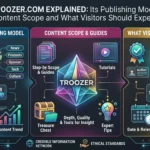
Understanding Troozer.com’s Digital Publishing Model
Digital publishing is the process of creating and distributing content through online channels.
Instead of relying on printed magazines or newspapers, digital publishers make articles, guides and other editorial material available through websites.
Troozer.com’s stated publishing model follows this general approach.
Its broad subject coverage allows readers with different interests to explore content through one domain. Someone interested in technology may also find articles about finance, education or business.
There are several important parts of this model.
1. Content Is the Main Offering
The central purpose of a publishing website is the information it provides.
Readers visit to explore articles, understand subjects and discover different perspectives. They do not necessarily need to register for a service or purchase a product.
This is the distinction Troozer makes in its public description: its focus is editorial publishing rather than offering software features or transactional services.
2. Multiple Categories Support Different Interests
A multi-category publication does not limit itself to one specialist topic.
Troozer identifies ten broad subject areas, allowing the website to cover different aspects of everyday life, professional interests and general knowledge.
This approach can appeal to readers who prefer exploring several topics through one publication.
However, a wide editorial scope does not automatically make every article an expert resource. The quality of information still depends on the individual article, its supporting evidence and its relevance.
3. Readers Can Explore Content Without a Mandatory Account
Troozer’s public statement says that visitors do not need to create an account to access its general content.
This is relevant because some online platforms require registration before visitors can use their services or read material.
An open-access publishing model is different. Its main purpose is to make editorial information available to readers without requiring them to become registered users.
Readers should still check the website’s current policies and any specific terms associated with individual pages.
4. Different Topics Can Exist Under One Publication
A single website can publish articles about technology, finance, health and property without being a specialist service in every one of those industries.
This is common in general-interest digital publishing.
For example, a publication may explain a basic financial concept in one article and discuss home improvement in another. Both subjects belong to the same publication, even though they serve different reader interests.
Troozer’s multi-category approach follows this broad publishing structure.
Exploring the Ten Content Categories on Troozer.com
Troozer’s public description identifies ten main subject areas. Each category provides a different editorial direction and may attract a different type of reader.
1. Technology
Technology covers developments in digital systems, software, computing and online services.
Readers interested in this category may want to understand emerging technologies, digital changes and the ways technology affects businesses and everyday activities.
Technology articles are especially useful when they explain unfamiliar terms in straightforward language.
However, information about software versions, product features and technical requirements can change. Readers should compare important details with the relevant developer’s documentation.
2. Finance
Finance is concerned with money, financial planning and related economic subjects.
General finance articles may help readers understand concepts such as savings, investments, borrowing and financial management.
These explanations can be useful for building basic knowledge, particularly for people who are unfamiliar with financial terminology.
However, a publishing website should not be confused with a bank, lender, investment provider or financial adviser.
Readers should confirm product conditions, fees, risks and current figures through official financial sources before making decisions.
3. Business
Business content can introduce readers to commercial subjects, entrepreneurship, organisations and workplace developments.
People exploring this category may be interested in understanding business concepts, discovering ideas or learning about changes affecting different industries.
Business information can be relevant to students, professionals and entrepreneurs.
Its practical value depends on whether an article explains its subject clearly and recognises that business decisions differ according to industry, location and available resources.
4. Health
Health-related content covers subjects associated with wellbeing, fitness and general medical information.
Readers may explore this category to understand common terminology or learn about general health topics.
Health articles should always be approached responsibly. General information cannot replace medical assessment, diagnosis or treatment.
For personal health concerns, consult a qualified healthcare professional rather than relying solely on an online article.
5. Education
Education focuses on learning, academic subjects and educational developments.
This category may appeal to students, parents, teachers and general readers who want to understand different learning-related topics.
Educational articles can introduce unfamiliar concepts and provide additional explanations.
However, students should continue to use prescribed textbooks, course materials and official academic guidance when preparing for examinations or completing assignments.
6. Lifestyle
Lifestyle includes everyday interests and subjects connected with personal routines, home life and general wellbeing.
Readers may explore lifestyle articles to discover ideas, understand common topics or find practical information.
The category has a broad scope because lifestyle interests vary considerably between individuals.
When following a suggestion, consider whether it is suitable for your personal circumstances rather than assuming every recommendation will work for everyone.
7. Travel
Travel content covers destinations, planning and subjects connected with visiting different places.
Readers may be interested in destination information, travel preparation and general guidance.
Travel details can change because of local regulations, weather, transport schedules and entry requirements.
Before booking or travelling, confirm important information with official tourism authorities, transport providers and relevant government websites.
8. Law
Law-related content introduces readers to legal subjects, terminology and general legal information.
Such articles may help people understand the background to a legal issue or become familiar with a particular concept.
However, legal rules depend on the jurisdiction and individual circumstances.
Readers should confirm applicable requirements through official legal sources and seek qualified legal advice when dealing with a specific legal matter.
9. Home Improvement
Home improvement covers subjects related to maintaining, upgrading and improving residential spaces.
Readers may explore ideas about renovation, household maintenance, interior improvements and practical home projects.
Before carrying out electrical, structural or other potentially dangerous work, check applicable regulations and consult a qualified professional.
General articles can provide background information, but they should not replace professional assessment.
10. Real Estate
Real estate covers property-related topics, including buying, selling, renting and understanding property markets.
Readers may use general articles to become familiar with industry terminology and common property considerations.
Property decisions can involve significant financial and legal commitments. Information about prices, taxes, regulations and contracts should be verified through official records and qualified professionals.
What Troozer.com Is Not: Understanding the Difference
One reason the Troozer name can be confusing is that different third-party websites have assigned it different descriptions.
Some articles have referred to it as an online marketplace, productivity workspace, AI platform or digital tool.
However, these descriptions do not match Troozer’s own public statement.
Understanding what the platform says it does not offer is just as important as understanding its publishing purpose.
Is Troozer.com an Online Marketplace?
Troozer’s public statement says it is not a marketplace.
It also states that the website does not operate transactions or payment systems.
Therefore, visitors should approach it as a publishing website rather than expecting product listings, shopping carts or checkout services.
If another website claims to sell products under the Troozer.com name, verify its domain and relationship with the publication before sharing payment information.
Is Troozer.com a Financial Service?
No. Troozer’s statement explicitly distinguishes its publishing platform from a financial service.
Publishing finance-related articles does not make a website a bank, lender, investment company or payment provider.
Readers should not confuse educational financial content with an actual financial product or service.
Is Troozer.com an AI Application?
Troozer also states that it is not a software tool.
A website may publish articles about artificial intelligence without providing an AI application itself.
Visitors looking for a chatbot, AI writing tool or automated software service should not assume that such a product is available simply because the publication covers technology-related subjects.
Is Troozer.com a Productivity Workspace?
A productivity workspace generally offers tools for organising work, managing tasks or collaborating with other users.
Troozer’s stated purpose is different. It identifies itself as an editorial publishing platform rather than a productivity application.
This distinction helps readers understand what to expect when visiting the domain.
How Should Readers Evaluate Content Published on Troozer.com?
Understanding the publishing model is only one part of using an online publication effectively.
Readers should also evaluate the information they find. This is particularly important when an article covers subjects such as finance, health, law or real estate.
Check the Article’s Publication Date
Some information remains relevant for years, while other details change frequently.
An explanation of a general technology concept may remain useful over time. However, an article about a current financial product or legal requirement may need regular updates.
Check the date before relying on time-sensitive information.
Look for Supporting References
Articles containing important statistics, financial figures or regulatory claims should ideally identify their sources.
When references are available, follow them to the original reports or official documents.
If an important claim cannot be verified, treat it cautiously.
Understand the Difference Between Information and Advice
A general article can explain how something works without recommending that every reader should follow the same approach.
For example, an article about property investment may introduce basic concepts, but it cannot determine whether a particular property is suitable for an individual.
Similarly, a health article cannot assess a person’s medical history.
Compare Important Details With Authoritative Sources
For important decisions, compare information with sources that have direct responsibility for the subject.
Examples include:
- Government websites for laws, regulations and public services.
- Banks and lenders for current financial product conditions.
- Healthcare organisations and qualified professionals for medical information.
- Educational institutions for academic requirements.
- Property authorities and legal professionals for real estate matters.
- Software developers for current technical documentation.
This habit helps readers use general-interest publications more responsibly.
Why Domain Verification Matters When Searching for Troozer
Domain names can create confusion, particularly when several websites use similar branding.
A reader searching for Troozer.com may encounter pages on other domains that use the same or a similar name.
These websites should not automatically be treated as connected.
For example, Troozer.com, Troozer.net and Troozer.io are separate domain names. Their content, services and published descriptions should be evaluated independently.
Before relying on information, check:
- The complete domain in the browser address bar.
- Whether the page belongs to the intended website.
- Whether the contact details match the correct domain.
- Whether the article refers to the same platform.
- Whether any claimed service is actually demonstrated on the website.
This is particularly important when a search result describes Troozer as an app or commercial service even though the domain’s own statement identifies it as a publisher.
Who May Find Troozer.com Useful?
A multi-category publication may appeal to people with different interests.
General Readers
People who enjoy learning about different subjects may find a broad publishing website useful for exploring unfamiliar topics.
Students
Students may use relevant educational articles as supplementary reading, provided they also consult official course material and academic references.
Entrepreneurs and Professionals
Business and technology content may help readers discover ideas and become familiar with industry-related subjects.
People Researching Everyday Topics
The lifestyle, travel, home improvement and real estate categories may interest readers looking for general background information.
The most useful approach is to choose articles according to a specific question and verify important details before acting on them.
Conclusion
Troozer.com is best understood through its stated purpose: a multi-category digital media and publishing platform.
Its ten identified subject areas cover technology, finance, business, health, education, lifestyle, travel, law, home improvement and real estate. This broad approach gives readers the opportunity to explore different interests through one publication.
The website also makes an important distinction about its role. It does not present itself as a shopping marketplace, financial service, productivity workspace or software tool. Its stated focus is editorial content.
For readers, understanding this distinction makes it easier to set the right expectations. Explore relevant articles, check their publication dates, look for supporting sources and verify important information before making decisions.
Ultimately, a digital publication is most useful when readers understand what it offers and how to assess the information it provides.
What is Troozer.com?
Troozer.com describes itself as a digital media and publishing platform that provides editorial content across multiple subject areas.
What is the main purpose of Troozer.com?
Its stated purpose is to publish information and articles for readers. It is not presented as an online marketplace, financial service or software application.
Which categories does Troozer.com cover?
Troozer identifies technology, finance, business, health, education, lifestyle, travel, law, home improvement and real estate as its ten broad subject areas.
Is Troozer.com an online shopping website?
No. Troozer’s public statement says that it is not a marketplace and does not operate a transaction or payment system.
Does Troozer.com provide financial services?
No. Although finance is one of its publishing categories, the platform identifies itself as a publisher rather than a financial service provider.