




Introduction
Researching a company can involve much more than visiting its website, reading its About page and checking a few search results. A business may present itself positively in public, but a serious assessment requires a broader view of its operations, market position, leadership, financial performance and potential risks.
A research dossier for target company helps bring that information together in one organised document. It gives sales professionals, marketers, investors, consultants and business owners a structured way to understand an organisation before making an important decision.
The real value comes from how the information is collected and evaluated. A list of company facts is useful, but a well-prepared intelligence report goes further by identifying evidence, explaining uncertainties and highlighting questions that need further investigation.
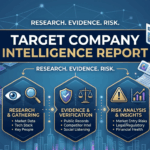
This guide explains how to build a practical company intelligence report, select credible sources, evaluate competitors, track risks and create a reusable research template.
Quick Answer: What Is a Research Dossier for a Target Company?
A research dossier for a target company is a structured document containing verified information and analysis about a business. It may cover the company’s identity, ownership, products, services, leadership, finances, customers, competitors, market position and business risks.
The purpose is to support a specific decision, such as qualifying a sales prospect, evaluating a supplier, researching a competitor, preparing for a partnership or assessing an investment opportunity.
A useful dossier should answer three questions:
- What do we know? The relevant facts about the company.
- How do we know it? The evidence and sources supporting each finding.
- What does it mean? The implications, uncertainties and possible next steps.
1. Why a Target Company Intelligence Report Matters
Business decisions often involve incomplete information. A sales representative may want to understand a potential customer before making contact. A marketing agency might need to identify a company’s growth opportunities, while a supplier may want to assess whether a prospective customer appears suitable for a commercial relationship.
Without a structured process, research can become a collection of disconnected notes, outdated figures and assumptions.
A company intelligence report creates a consistent framework for gathering the information that matters.
It improves preparation
Before a business meeting, a dossier can help you understand what the organisation does, who its customers are and which business challenges may be relevant to the discussion.
Consequently, conversations can focus on useful questions rather than basic information that could have been researched beforehand.
It supports more informed decisions
Investors, buyers and business partners need to understand both opportunities and risks. A company’s impressive marketing materials may explain its ambitions, but they do not necessarily establish its financial condition, operational strength or long-term prospects.
A structured report makes it easier to compare the company’s claims with available evidence.
It reduces duplicated work
When research findings, source links and dates are stored in one place, team members can reuse verified information instead of repeating the same searches.
This is particularly useful for sales teams, account managers, consultants and organisations that regularly research multiple companies.
2. Define the Purpose of Your Research
Start by deciding why you are researching the company. This step determines which information deserves the most attention.
For example, a sales team does not need the same level of financial analysis as an investor evaluating a possible acquisition. Likewise, a marketing agency may focus on customer segments, online visibility, competitors and potential growth opportunities.
| Research purpose | Areas to prioritise |
|---|---|
| Sales prospecting | Products, target customers, decision-makers, business priorities and potential needs |
| Competitor analysis | Services, pricing where publicly available, positioning, customer segments and differentiation |
| Investment research | Financial statements, performance trends, ownership, business risks and disclosures |
| Supplier assessment | Legal identity, operating capability, service history, financial resilience and contractual risks |
| Partnership evaluation | Strategic fit, reputation, complementary capabilities and commercial objectives |
| Marketing research | Website, audience, search visibility, content, customer reviews and competitors |
| Job interview preparation | Business model, products, leadership, recent developments and role-related challenges |
A clear research objective prevents the report from becoming unnecessarily long.
Write a research question
Before collecting information, write one sentence describing the decision you need to support.
For example:
Can this company be a suitable long-term supplier based on its verified business identity, service capabilities, operating history and identifiable risks?
Every major section should help answer that question. If a detail does not contribute to the decision, it may not belong in the main report.
3. Confirm the Company’s Identity
Company identification is one of the most important early steps. Businesses may use trading names, brand names, subsidiaries or similar names across different markets.
Researching the wrong entity can undermine the entire dossier.
Information to collect
Record the following details where they are publicly available and relevant:
- Full legal company name.
- Trading name or primary brand.
- Official website and business domain.
- Country and jurisdiction of registration.
- Company registration number, where applicable.
- Registered office or principal business location.
- Incorporation date or operating history.
- Parent company and subsidiaries, if verified.
- Relevant registration status and filing information.
Check official business registers
For UK companies, the Companies House register provides access to company records, including filing documents and officer information. However, Companies House explicitly notes that it does not check the accuracy of information filed, so records should be interpreted carefully and corroborated when necessary.
For companies that file with the US Securities and Exchange Commission, SEC EDGAR provides public access to company filings, including registration statements and periodic reports. Researchers can search using a company name, ticker symbol or Central Index Key (CIK).
Other countries have their own corporate registries. Select the register that corresponds to the company’s actual legal jurisdiction rather than assuming that its website domain or headquarters identifies the correct entity.
Do not confuse a missing result with wrongdoing
A company may not appear under its brand name because it is registered under a different legal name, operates through a parent entity or is structured differently from what you expected.
If an initial search returns nothing, record the exact name and register searched. Then investigate reasonable alternatives before drawing conclusions.
4. Build a Complete Company Profile
Once you have confirmed the organisation, create a concise profile that gives readers a clear picture of its background and operations.
Company background
Include the founding date, company history, main operating locations and major publicly documented milestones. Distinguish between facts reported by the company and information independently confirmed by other sources.
Leadership and ownership
Identify relevant executives, founders, directors and ownership information when available from reliable sources.
For public companies, official filings may explain executive responsibilities, share ownership and governance arrangements. Private-company ownership can be harder to establish, depending on the jurisdiction and information available.
Do not assume that a founder still manages the business or that a person mentioned in an old article remains in the same role.
Products, services and customers
Summarise what the organisation sells, whom it serves and which markets it targets.
A software company might offer subscription-based products to other businesses, while a manufacturer may sell through distributors. Understanding this distinction helps explain how the company operates and competes.
Organisational overview
Where reliable information exists, note the company’s locations, business units, workforce indicators and operating regions.
Employee counts and similar figures should include a source and date. A company profile is more useful when readers can distinguish current information from historical data.
5. Investigate Products, Services and Business Models
A company may offer numerous products, but not every product contributes equally to its strategy or revenue. Your dossier should explain how the organisation creates value and earns money.
Identify its main offerings
Create a list of its principal products and services. For each one, record:
- The problem it claims to solve.
- Its intended customer group.
- Its main features or service components.
- The way it is delivered.
- Publicly available pricing or commercial terms.
- The benefits emphasised in the company’s marketing.
Use phrases such as “the company states” when describing unverified claims from its own website.
Understand the revenue model
Depending on the business, revenue may come from subscriptions, one-off sales, licensing, advertising, commissions, service contracts or a combination of methods.
Understanding the model helps you ask better questions about the company’s growth and risks.
For instance, a subscription business may depend on retaining customers, whereas a project-based consultancy may depend more heavily on securing new contracts and maintaining delivery capacity.
Do not assume that a company’s advertised pricing reveals its actual revenue, profit margin or customer lifetime value. Those figures require separate evidence.
Identify differentiation
Assess how the business presents itself relative to alternatives. Its positioning may focus on price, service quality, specialist expertise, distribution, technology, convenience or customer support.
Where possible, compare these claims with independent customer feedback, product documentation and competitor offerings.
The objective is not to repeat the company’s promotional language. Instead, determine what appears distinctive and what still needs verification.
6. Assess Financial and Operational Information
Financial research can help explain a company’s scale, performance and resilience. The depth of this section should match your research purpose and the information that is legally available.
Financial information
For companies with public financial disclosures, examine relevant measures such as:
- Revenue and its change over time.
- Operating income or operating loss.
- Net income or loss.
- Cash flow.
- Debt and other reported obligations.
- Cash and liquidity indicators.
- Segment or geographic performance, where disclosed.
Avoid interpreting a single metric in isolation. Revenue growth, for example, does not automatically mean that profitability or cash generation has improved.
Comparisons also need consistent reporting periods, currency and accounting definitions.
Operational capability
A company may look attractive commercially but still face operational constraints. Depending on the organisation, investigate its delivery model, geographic coverage, supply chain, service capacity and dependence on key suppliers.
For a service provider, public case studies and customer references may offer clues about experience. For a manufacturer, available product documentation and regulatory records may be more relevant.
When financial information is unavailable
Private businesses do not necessarily publish the same financial detail as listed companies. Do not fill these gaps with invented estimates or unsupported third-party figures.
Instead, mark the information as unavailable from the sources checked. If the decision requires financial verification, request appropriate documentation through a lawful and authorised process.
7. Research Competitors and Market Position
A company cannot be evaluated properly without understanding the alternatives available to its customers.
Competitor analysis helps explain where the business operates, what makes it different and which external pressures may affect its performance.
Identify direct and indirect competitors
Direct competitors provide similar products or services to a similar audience. Indirect competitors solve the same customer problem in another way.
For example, a business offering email marketing software may compete directly with other email platforms. It may also face indirect competition from broader customer relationship management tools that include email functionality.
Compare competitors systematically
Use a table to make differences visible.
| Comparison factor | Target company | Competitor A | Competitor B |
|---|---|---|---|
| Main offering | Verified product or service | Verified product or service | Verified product or service |
| Target customers | Identified audience | Identified audience | Identified audience |
| Pricing | Publicly confirmed or unavailable | Publicly confirmed or unavailable | Publicly confirmed or unavailable |
| Key differentiator | Evidence-based finding | Evidence-based finding | Evidence-based finding |
| Market coverage | Verified locations or regions | Verified locations or regions | Verified locations or regions |
| Main uncertainty | Information still required | Information still required | Information still required |
Keep the comparison fair. If one company’s price comes from a public pricing page and another’s comes from an old third-party article, the figures may not be directly comparable.
Review market conditions
Consider industry trends, customer expectations, new technologies, regulation and changes in distribution. Use relevant government statistics, industry associations, company filings and credible research publications when available.
Clearly distinguish market-wide evidence from conclusions about the individual company.
8. Evaluate Reputation and Business Risks
A useful dossier examines what could go wrong as well as what could create opportunities.
Risk assessment should be tied to the decision you are making. A potential supplier, investment target and sales prospect will not have identical risk priorities.
Areas to investigate
Financial risk: Relevant concerns may include reported losses, debt obligations, liquidity pressures or reliance on limited revenue sources.
Operational risk: Consider delivery constraints, supplier concentration, service interruptions and dependence on key personnel.
Legal and regulatory risk: Review relevant official records and disclosures where available. A search result or allegation should not be presented as a confirmed legal finding.
Reputational risk: Examine customer feedback, documented complaints and credible reporting. Consider the date, context and representativeness of the evidence.
Market risk: Assess changing customer preferences, competitive pressure, technology shifts and dependence on a particular segment.
Cybersecurity and privacy risk: Where relevant, review published security documentation, incident disclosures and applicable compliance statements. Do not infer that a company is secure simply because no incident appears in a basic search.
Separate evidence from interpretation
Use clear labels when writing risk findings.
- Confirmed fact: Supported directly by an authoritative source.
- Company statement: Published by the organisation but not independently verified.
- Third-party report: Reported by another source and requiring appropriate context.
- Analysis: Your interpretation of available evidence.
- Open question: A material issue that remains unresolved.
This distinction helps prevent assumptions from becoming apparent facts.
9. Find Reliable Company Research Sources
Source quality is central to a trustworthy dossier. Begin with primary sources, then use independent reporting to add context and test important claims.
Official company sources
The company’s website, investor relations pages, annual reports, product documentation and formal announcements can establish what the organisation says about itself.
These sources are valuable for understanding its products and strategy, but promotional claims should not automatically be treated as independently verified findings.
Government and regulatory databases
Corporate registries and securities regulators may provide legal identity information, filings, disclosures and other official records.
Examples include:
- SEC EDGAR for relevant US securities filings.
- Companies House for UK company records.
Check the scope of each database. A register’s existence does not mean it contains every fact needed to assess a company.
Independent sources
Credible financial journalism, industry publications, professional research and relevant trade associations can provide additional context.
Compare reporting dates and methods. If multiple articles repeat the same original announcement, they may not represent independent confirmation.
Customer and market feedback
Reviews, public forums and testimonials can reveal themes worth investigating. Nevertheless, individual reviews may be unrepresentative, and testimonials selected by a company are not a balanced measure of overall performance.
Treat this information as one part of the evidence base, not a substitute for formal records.
10. Create an Evidence-Tracking System
An evidence log records where a finding came from, when it was checked and how confidently it can be used.
Without this record, even a well-written report can become difficult to verify or update.
Recommended evidence log
| Research claim | Source | Date checked | Evidence type | Confidence or status |
|---|---|---|---|---|
| Legal company name | Official register | Add date | Primary record | Confirmed against record |
| Main product offering | Company website | Add date | Company statement | Published claim |
| Revenue figure | Financial filing | Add date | Primary financial source | Verify reporting period |
| Competitor pricing | Official pricing page | Add date | Primary source | Confirm current terms |
| Customer satisfaction concern | Review or independent report | Add date | Third-party source | Requires context |
Confidence labels are an internal research aid, not a universal certification. Explain the standard your team uses, especially when different people contribute to the same dossier.
Record missing information
If you cannot establish a fact, write “Not found in the sources checked” and document where you looked.
This is more accurate than concluding that the information does not exist. It also gives the next researcher a clear starting point.
11. A Step-by-Step Company Research Workflow
A repeatable workflow helps keep research focused and makes it easier to produce consistent reports.
Step 1: Define the decision
Write the research objective and list the questions the report must answer.
Step 2: Confirm the correct entity
Verify the legal name, official domain and relevant jurisdiction. Resolve any confusion caused by similarly named businesses.
Step 3: Collect primary sources
Start with company disclosures, official registers, regulatory records and other sources that directly support the research questions.
Step 4: Add independent context
Search credible reporting, industry research and relevant customer feedback. Record source dates and distinguish original reporting from repeated coverage.
Step 5: Analyse the business
Review its offerings, business model, customers, market position, financial information and operating structure where evidence is available.
Step 6: Compare alternatives
Identify relevant competitors and compare them using consistent criteria.
Step 7: Evaluate risks and uncertainties
Prioritise issues that could materially affect the decision. Record the evidence supporting each risk and what additional information could change the assessment.
Step 8: Write the executive summary
Summarise the most important findings, key uncertainties and recommended next steps. Write this section after the evidence has been reviewed, not before.
Step 9: Review and update
Check source links, dates, names and calculations. Set a review date appropriate to the subject and decision; rapidly changing information may need checking sooner than stable company background details.
12. Target Company Research Dossier Template
Use the following structure as a starting point for a new report. Adapt it to your objective rather than treating every field as compulsory.
Company identification
- Legal company name:
- Trading name:
- Official website:
- Registration jurisdiction:
- Registration number:
- Headquarters or main operating location:
- Date research began:
- Research purpose:
Business profile
- Company background:
- Main products and services:
- Target customers:
- Revenue model:
- Operating regions:
- Relevant leadership:
- Parent company or subsidiaries, if confirmed:
Financial and operational overview
- Available financial disclosures:
- Revenue and profitability trends, where reported:
- Operational capabilities:
- Important dependencies:
- Information unavailable from the sources checked:
Market and competitors
- Main market:
- Direct competitors:
- Indirect competitors:
- Differentiation:
- Relevant industry trends:
- Opportunities requiring further validation:
Risk and evidence review
- Material financial or operational risks:
- Relevant legal or regulatory records:
- Reputation findings:
- Source conflicts:
- Unverified claims:
- Outstanding questions:
Executive conclusion
- Most important findings:
- Main opportunities:
- Main risks:
- Confidence in the available evidence:
- Recommended next step:
- Next review date:
Final quality check
Before sharing the report, make sure each material claim has a source, dates are clear, uncertainty is visible and the conclusion follows from the evidence presented.
13. Common Research Mistakes
Even extensive research can lead to poor decisions if the process is not disciplined.
Collecting facts without a goal: A long company history may add little value if the decision concerns supplier reliability. Prioritise information that answers the original research questions.
Trusting the company’s marketing without verification: Official material helps explain the organisation’s claims, but independent evidence may be needed to assess their accuracy.
Mixing estimates with confirmed figures: Label estimates clearly and include their source, date and methodology when available.
Using outdated information: Leadership, pricing, products and financial conditions can change. Check dates before treating a finding as current.
Drawing conclusions from missing data: A lack of public information does not prove misconduct, financial weakness or operational failure.
Ignoring conflicting sources: Record the disagreement and investigate it instead of silently selecting the figure that supports your preferred conclusion.
Making unsupported allegations: Describe documented facts precisely, distinguish allegations from findings and avoid presenting unverified claims as established wrongdoing.
Failing to update the dossier: A report becomes less useful when its evidence is stale. Assign responsibility for reviewing important information when the decision requires ongoing monitoring.
14. Final Thoughts
A research dossier target company is most valuable when it helps someone make a better-informed decision. It should not simply collect company descriptions, news articles and financial figures. Instead, it should connect reliable evidence with a clear research objective.
Begin by confirming the correct business and identifying the questions that matter. Gather primary records, add independent context, compare competitors and assess risks without confusing assumptions with facts.
Finally, record your sources, dates and unresolved questions. This makes the dossier easier to verify, update and share with colleagues.
Whether you are preparing for a sales meeting, reviewing a potential supplier, researching a competitor or assessing a business opportunity, a structured intelligence report can turn scattered information into a practical decision-making resource.
What is the difference between a company profile and a research dossier?
A company profile usually summarises an organisation’s background, products and operations. A research dossier goes further by documenting sources, evaluating evidence, comparing alternatives and assessing risks relevant to a specific decision.
Who needs a target company research dossier?
Sales professionals, marketers, investors, consultants, procurement teams, business owners and researchers may all benefit from one. The structure should reflect the purpose of the research and the level of evidence required.
Can I create a company research dossier using free sources?
Yes, many useful records are publicly accessible. Depending on the company and jurisdiction, you may find official filings, company announcements, product information and market data without paying for a research platform. However, some records and specialist reports may require a fee or authorised access
How long should a research dossier be?
There is no universal length. A prospect briefing might be a few pages, while an investment or acquisition assessment may require substantially more analysis. Prioritise completeness, traceability and decision relevance over page count.
How do I know whether a source is reliable?
Check who published it, whether it links to original evidence, when it was published and whether the claim can be corroborated. Official records are often useful for legal filings, while independent reporting can provide additional context. No single source type answers every question.