




England vs South Africa: A Rivalry Built on Competitive Cricket
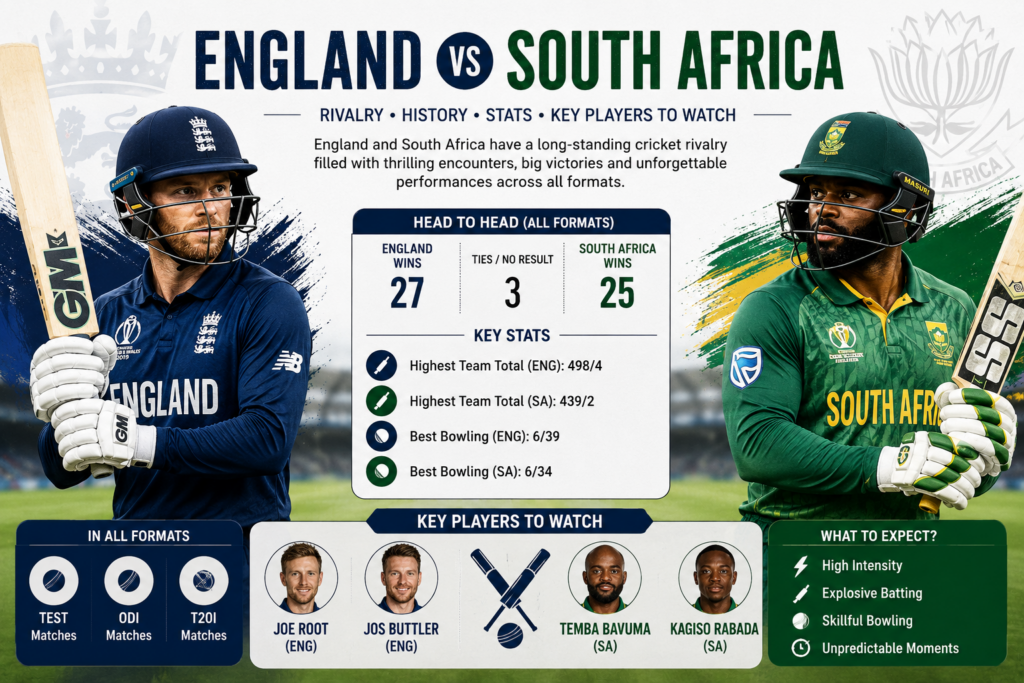
Few international cricket contests consistently produce the feeling that one good session could change everything. England vs South Africa is one of them. The two sides have met across Tests, ODIs and T20Is for decades, producing close finishes, major tournament encounters and individual performances that remain part of cricket conversation. Their contrasting styles—England’s aggressive approach and South Africa’s athletic, pace-heavy tradition—make this a matchup worth watching whenever the teams meet.
Quick Summary
- England and South Africa have a long-running rivalry across all three major international formats.
- Test cricket has traditionally been an important part of their cricketing relationship.
- Both teams have produced world-class fast bowlers, batters and all-rounders.
- Their World Cup meetings have often carried significant tournament implications.
- Conditions can dramatically influence the balance between the two sides.
- Individual performances frequently determine the outcome when the teams are closely matched.
How Did the England vs South Africa Cricket Rivalry Develop?
The cricket relationship between England and South Africa dates back to 1889, when South Africa played its first Test match against England at Port Elizabeth, now known as Gqeberha. That fixture marked the beginning of one of international cricket’s longest-running contests.
Over the years, the rivalry evolved through different generations of players and changing styles of cricket. England traditionally built teams around strong top-order batting, seam bowling and disciplined Test cricket. South Africa developed a reputation for producing outstanding fast bowlers and technically accomplished batsmen.
The modern rivalry looks different from the cricket played more than a century ago. T20 cricket has introduced a faster tactical dimension, while limited-overs cricket has placed greater emphasis on power hitting, fielding and specialist death bowling.
Still, one feature remains familiar: neither side is particularly comfortable giving the other an easy game.
Why is this rivalry significant?
England and South Africa are both historically important cricket nations, and their encounters regularly attract attention because they feature players capable of changing a match quickly.
The rivalry also has a geographical element. English conditions can favour swing and seam bowling, while South African pitches have traditionally offered pace and bounce. That makes a tour between the countries a genuine examination of technique.
What Makes England vs South Africa Matches So Competitive?
The balance between the teams often comes down to how effectively their strengths match the conditions.
England’s strengths
England’s white-ball cricket has undergone a major transformation over the past decade. The team became particularly associated with aggressive batting, flexible line-ups and a willingness to attack from the opening overs.
In Test cricket, England’s approach under the “Bazball” era has also encouraged positive intent. Rather than simply waiting for opportunities, batters are often encouraged to keep pressure on the opposition.
Players such as Joe Root, Ben Stokes and several generations of English fast bowlers have played important roles in the team’s success.
South Africa’s strengths
South Africa’s traditional strength has been fast bowling. The country has produced bowlers capable of generating serious pace, movement and bounce, making South Africa particularly dangerous when conditions favour seamers.
The Proteas have also developed a strong group of aggressive white-ball batters. When their top order gets through the first phase of an innings, the middle and lower order can accelerate quickly.
The combination of pace bowling and athletic fielding gives South Africa a style that can disrupt even experienced batting line-ups.
England vs South Africa in Test Cricket
Test cricket gives this rivalry a different character. Five-day matches allow momentum to move back and forth, and a team that appears to be in trouble on the first morning can still dominate by the fourth day.
What should fans watch for in a Test?
The opening spell is often crucial. English seamers can exploit movement, particularly when the ball is new, while South Africa’s quick bowlers can create problems with pace and bounce.
Batting technique becomes equally important. Top-order players must decide when to attack and when to leave the ball. A century in challenging conditions can be worth far more than a quick fifty on a flat pitch.
Spin can also become relevant as a Test progresses. If the surface deteriorates, spinners and reverse swing may become increasingly influential.
Key Test players
Joe Root has been one of England’s defining Test batters of the modern era, while Ben Stokes has contributed with both bat and ball.
South Africa have likewise produced outstanding Test players, including fast bowlers and technically strong top-order batters. The exact balance changes from series to series, but the contest between England’s batting and South Africa’s pace attack is often central to the result.
How Have England and South Africa Performed in Limited-Overs Cricket?
Limited-overs matches between the teams tend to be more volatile. A single over can change the entire contest.
In ODIs, both sides have historically relied on strong batting depth. The middle overs are particularly important because teams must balance scoring quickly with preserving wickets for the final 10 overs.
T20 cricket creates an even smaller margin for error. A poor powerplay can put a team under immediate pressure, while one explosive innings can completely reverse the situation.
England’s white-ball approach
England became one of the most aggressive teams in international white-ball cricket, particularly after their disappointing 2015 ODI World Cup campaign. Their approach emphasised attacking batting and greater depth.
That philosophy helped England win the 2019 Men’s Cricket World Cup, defeating New Zealand in the final at Lord’s.
South Africa’s limited-overs challenge
South Africa have consistently possessed talented limited-overs squads, but major tournament knockout matches have sometimes proved difficult.
That history adds another layer to England vs South Africa matches. When the sides meet at a World Cup, the result can carry much greater significance than a bilateral fixture.
England vs South Africa at Major ICC Tournaments
Some of the most memorable encounters between the teams have occurred at ICC events.
The 1992 World Cup semi-final remains one of the most famous matches in cricket history. South Africa were chasing a revised target against England after rain interrupted the match. The complicated rain-rule calculation produced a dramatic ending and eliminated South Africa.
Decades later, England and South Africa continued to meet in important World Cup games.
Their 2019 World Cup opening match at The Oval was another notable contest. England won convincingly, beginning their successful campaign with a strong performance against the Proteas.
The teams have also met in T20 World Cups, where the shorter format creates a completely different tactical challenge.
These tournament encounters matter because neither side can simply look ahead to another match. A defeat may have immediate consequences for qualification or knockout-stage progression.
Which Players Can Change an England vs South Africa Match?
A rivalry involving two deep talent pools inevitably produces plenty of individual battles.
Joe Root
Root’s ability to build long Test innings has made him one of England’s most dependable batters. His ability to rotate strike while punishing loose deliveries makes him particularly valuable against high-quality pace attacks.
Ben Stokes
Stokes brings an unusual combination of batting power, bowling ability and big-match temperament. His influence isn’t always reflected by one statistic. He can change a match through a spell of bowling, an aggressive innings or a crucial catch.
Kagiso Rabada
Rabada has been one of South Africa’s leading fast bowlers of the modern era. His pace, accuracy and ability to take wickets with the new and old ball make him a significant threat to England’s batting.
Quinton de Kock
During his international career, de Kock established himself as one of South Africa’s most destructive white-ball opening batters. His ability to score rapidly in the powerplay often put opposition teams under immediate pressure.
The specific player battles change as generations move on, but the principle remains the same: one outstanding individual can decide an otherwise evenly balanced match.
What Should You Expect From the Next England vs South Africa Match?
The answer depends heavily on the format and venue.
A Test in England could place greater emphasis on swing bowling and patience. A South African Test may reward pace and bounce. In T20 cricket, pitch conditions, toss decisions and powerplay batting can become more important.
For fans following a particular match, the most useful statistics to monitor include:
- Opening partnership
- Powerplay run rate
- Wickets lost during the middle overs
- Economy rate of frontline bowlers
- Death-over scoring
- Boundary percentage
- Catching and fielding efficiency
These numbers often explain why a match turned in one direction, rather than simply showing who scored the most runs.
England vs South Africa Head-to-Head: Why Context Matters
Head-to-head statistics are useful, but they need context. Test, ODI and T20I records represent very different forms of cricket.
A team might have an advantage in one format while struggling against the same opponent in another. Venue also matters. So does the generation of players involved.
For example, a Test played in Johannesburg should not be analysed in exactly the same way as a T20I played in England. Pitch behaviour, match length and tactical priorities are completely different.
That’s why a useful England vs South Africa head-to-head comparison should consider the format, venue, date and competition rather than relying on a single overall win-loss number.
Frequently Asked Questions
When did England and South Africa first play Test cricket?
England and South Africa played their first Test against each other in 1889 at Port Elizabeth. South Africa’s debut Test made the country the third Test-playing nation after England and Australia.
Who has the stronger England vs South Africa cricket record?
There is no single answer across every format. The teams have experienced different periods of dominance in Tests, ODIs and T20Is, so head-to-head records should be examined separately by format.
Have England and South Africa played in World Cups?
Yes. England and South Africa have met several times in ICC World Cups, including the 1992 semi-final and the 2019 tournament. Their World Cup meetings have often carried significant consequences.
Why are England vs South Africa matches so competitive?
Both teams possess high-quality pace bowling, experienced batters and strong fielding units. Conditions can also favour different strengths, making tactical decisions and individual performances especially important.
Conclusion
England vs South Africa remains one of cricket’s most intriguing international matchups. Its history stretches back to the nineteenth century, yet the rivalry continues to evolve with every generation. From dramatic World Cup encounters to demanding Test series and fast-paced T20 contests, the two teams offer contrasting strengths and plenty of tactical intrigue. For fans, the best way to understand each match is to look beyond the final score and consider conditions, player form and the key moments that shifted momentum.

Other Articles

Nigeria Women vs Zimbabwe Women: Cricket Rivalry & Results
Afghanistan vs Sri Lanka Match Scorecard: Asia Cup